
The Visayan Language Family Tree: All 30+ Bisayan Languages, Mapped
What Is the Visayan Language Family?
The Visayan language family — also called Bisayan — is a group of more than thirty closely related Austronesian languages spoken across the central Philippines and large parts of Mindanao. Together, the family has around 30 million native speakers, making it the largest language grouping in the country.
Visayan sits inside the larger Greater Central Philippine branch of the Malayo-Polynesian subfamily of Austronesian — the same enormous family that stretches from Madagascar to Hawaii.
This guide walks you through the canonical five-branch classification (Cebuan, Central, Western, South, and Eastern), shows where each branch is spoken, and lists the member languages. The classification follows the standard set by R. David Zorc's 1977 dissertation The Bisayan Dialects of the Philippines: Subgrouping and Reconstruction — still the foundational text for Visayan linguistics.
The Family Tree
Here's the whole family at a glance:
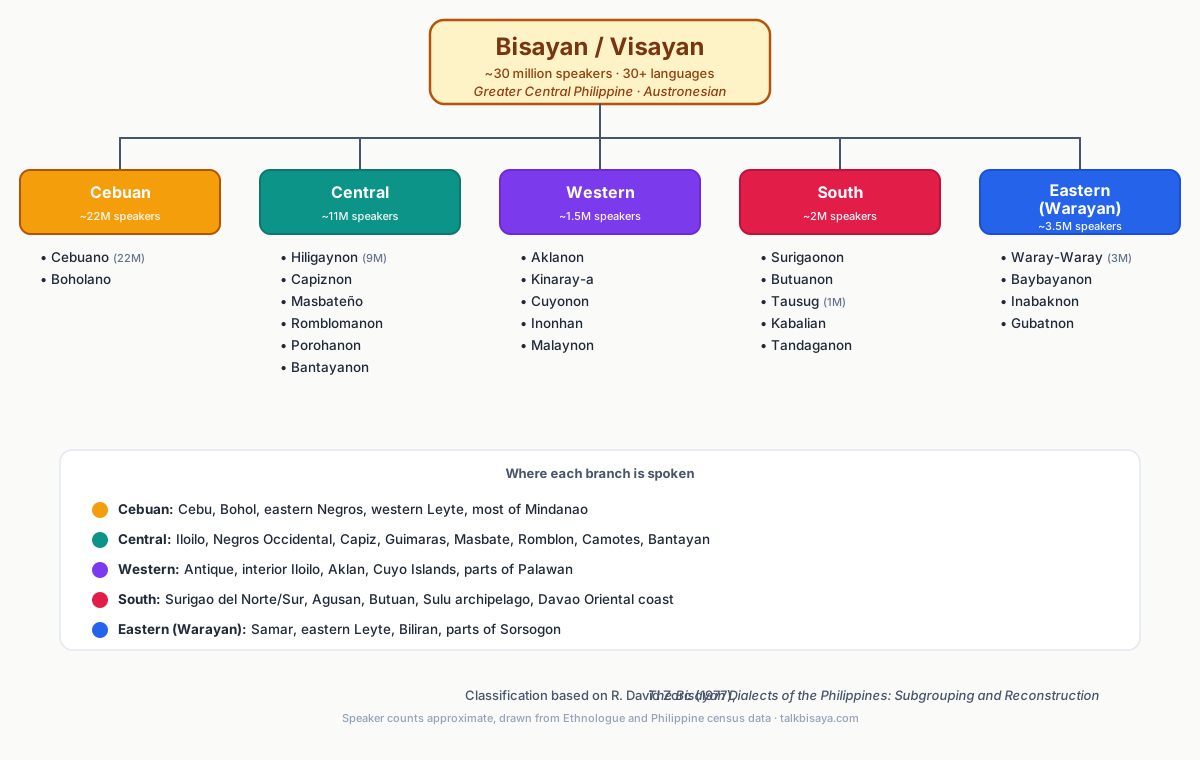
The five branches each have distinct sound patterns, vocabulary cores, and geographies. They're related — but not always mutually intelligible. A Cebuano speaker can usually follow a Boholano with no trouble, struggle with Hiligaynon, and lose Waray almost entirely.
Let's walk through each branch.
1. Cebuan — the Largest Branch
The Cebuan subgroup contains the giant of the Visayan family: Cebuano, with around 22 million native speakers. It's by far the most widely spoken Visayan language and one of the most spoken languages in the entire Philippines, second only to Tagalog.
Member languages:
- Cebuano (Sinugboanon, Bisaya) — Cebu, Bohol, eastern Negros, Siquijor, western Leyte, and most of northern and eastern Mindanao
- Boholano — closely related to Cebuano, often classified as a dialect; spoken in Bohol with distinctive pronunciation features (the famous "j" for "y" shift, glottal stops)
Cebuano serves as the lingua franca of Mindanao — when a Davaoeño meets a Cagay-anon meets a Surigaonon, they default to Cebuano even though their first languages may differ.
2. Central Visayan — the Western Heartland
The Central subgroup is the second-largest Visayan branch, anchored by Hiligaynon (also called Ilonggo) with around 9 million speakers. The Central branch dominates the western Visayas and parts of nearby islands.
Member languages:
- Hiligaynon (Ilonggo) — Iloilo, Negros Occidental, Guimaras, parts of Capiz, parts of Mindanao
- Capiznon — Capiz province
- Masbateño (Minasbate) — Masbate
- Romblomanon — Romblon
- Porohanon — Camotes Islands (between Cebu and Leyte)
- Bantayanon — Bantayan Island, off northern Cebu
Hiligaynon is famous for its melodic, almost-singing intonation. Cebuanos sometimes describe Ilonggo as "daw nagaawit" — like singing. The Central branch shares vocabulary with both the Western and Cebuan branches but has its own grammatical fingerprints.
3. Western Visayan — the Older Cousins
The Western subgroup (sometimes called Hiligaynon-Akeanon in older classifications) sits in the interior of Panay Island and surrounding small islands. These languages preserve features the bigger languages have lost — they're often described as "older sounding."
Member languages:
- Aklanon — Aklan province (home of Boracay)
- Kinaray-a (Hiniraya) — Antique province, interior Iloilo
- Cuyonon — Cuyo Islands and parts of Palawan; was the lingua franca of Spanish-colonial Palawan
- Inonhan (Looknon) — Tablas, Romblon
- Malaynon — Malay, Aklan
Two distinctive features mark the Western branch:
- Kinaray-a preserves the schwa vowel ("ə") that most Visayan languages have dropped
- Aklanon has the famous "l̥" — a voiceless velar fricative unique among Philippine languages, written as l but pronounced like a soft hiss
If you've ever heard an Aklanon say "buláwan" (gold) and noticed it doesn't sound like any l you've heard before — that's the l̥ at work.
4. South Visayan — the Mindanao Branch
The South subgroup spreads across northeastern Mindanao and the Sulu archipelago. It includes one of the most historically significant languages in Philippine history — Tausug — and several smaller languages clustered around Surigao and Butuan.
Member languages:
- Surigaonon — Surigao del Norte and Sur, parts of Agusan
- Butuanon — Butuan area; one of the oldest documented Philippine languages, with inscriptions dating back to the 14th century
- Tausug (Bahasa Sūg) — Sulu, Tawi-Tawi, parts of Basilan, Zamboanga, and Sabah, Malaysia; the language of the historic Sulu Sultanate
- Kabalian — southern Leyte
- Tandaganon — Tandag, Surigao del Sur
The South branch is genealogically Visayan but feels different to outsiders because it absorbed heavy Arabic, Malay, and Spanish vocabulary through centuries of trade and Islamic contact (especially Tausug).
5. Eastern Visayan (Warayan) — the Samar-Leyte Family
The Eastern branch — also called Warayan — is anchored by Waray-Waray, with about 3 million speakers. It dominates Samar and eastern Leyte and is the most distinct from Cebuano of all major Visayan branches.
Member languages:
- Waray-Waray (Samar-Leyte) — Samar (all three provinces), eastern Leyte, Biliran
- Baybayanon — coastal southern Leyte
- Inabaknon (Abaknon) — Capul Island, Northern Samar; sometimes classified separately as a Sama-Bajaw language despite Visayan substrate
- Gubatnon — small enclaves in Sorsogon
Waray and Cebuano share only about 30 percent of their core vocabulary, so a Cebuano hearing Waray for the first time often understands almost nothing. Distinctive Waray features:
- Diin? — Where? (Cebuano: Asa?)
- Ano? — What? (Cebuano: Unsa?)
- Heavy use of the particle "la" for emphasis
- A reputation for being fast-spoken and percussive
How Did the Branches Develop?
According to Zorc's reconstruction, Proto-Bisayan — the ancestor of all five branches — was spoken roughly 1,500 to 2,000 years ago, somewhere in the central Visayas. As speakers migrated to new islands, communities became geographically isolated, and the language diverged into the modern branches we see today.
Key historical drivers:
- Island geography — narrow seas connect the Visayas, but daily contact between distant islands was limited
- Trade routes — coastal Visayan languages absorbed loanwords from Malay, Arabic, Sanskrit, and Chinese centuries before Spanish contact
- Spanish colonization (1565 onwards) — added a thick layer of Spanish vocabulary, especially in numbers, religion, and administration
- 20th-century mobility — Cebuano spread rapidly across Mindanao with the agricultural migrations of the 1900s
Mutual Intelligibility: Who Understands Whom?
A rough guide to which Visayan speakers can follow each other:
- Cebuano ↔ Boholano — almost fully mutual (same branch, dialect-level differences)
- Cebuano ↔ Surigaonon — partial (South branch shares vocabulary)
- Cebuano ↔ Hiligaynon — about 50–60 percent (different branches but heavy contact)
- Cebuano ↔ Waray — limited (roughly 30 percent vocabulary overlap)
- Hiligaynon ↔ Kinaray-a — strong (Hiligaynon partly evolved from Kinaray-a)
- Hiligaynon ↔ Aklanon — partial (historical contact)
- Tausug ↔ anything else — minimal (too much Arabic/Malay influence)
In other words, "knowing Bisaya" doesn't automatically give you any other Visayan language — it gives you a head start, nothing more.
Why "Bisaya" Causes So Much Confusion
Outside the Philippines — and even in Manila — people often use "Bisaya" as a single language name. To linguists and to most native speakers, Bisaya is the family, not one language. When a Cebuano says "Bisaya ko," she usually means "I speak Cebuano" (using Bisaya as the local name for her variety). When an Ilonggo says it, she usually means "I'm Visayan" in the ethnic sense and would call her language Ilonggo or Hiligaynon.
This is why the family-tree view matters: it lets you ask "Which Bisaya?" and get a precise answer.
Which Visayan Should You Learn?
For most learners, Cebuano is the right first language to study:
- 22 million native speakers — biggest community
- Dominant in Mindanao — useful from Cagayan de Oro to Davao to Surigao
- Best resources — dictionaries (Wolff 1972), apps, courses, online content
- Mutual intelligibility reach — gives you partial access to Boholano, Surigaonon, and others
Pick differently if your destination calls for it: Hiligaynon for Iloilo and Bacolod, Waray-Waray for Tacloban and Samar, Tausug for Sulu, Kinaray-a for the Antique heartland.
Conclusion
The Visayan language family is one of the great branching trees of the Austronesian world — five major subgroups, more than thirty languages, 30 million voices, all descended from a single ancestor that scattered across the central Philippines over centuries.
When you learn one Visayan language, you're not just picking up vocabulary — you're stepping into one specific corner of a much larger linguistic world. The tree above is your map. Pick a branch and start climbing.
Want to start with the largest branch? Read our Cebuano beginner's guide, explore everyday Bisaya phrases, or compare Bisaya with Tagalog in our side-by-side breakdown.
Source: R. David Zorc (1977). The Bisayan Dialects of the Philippines: Subgrouping and Reconstruction. Available at zorc.net/publications/019=Bisayan_Zorc1977.pdf — the foundational linguistic study of the Visayan family.
Ready to Start Learning Bisaya?
Explore our free lessons, phrase guides, and interactive practice exercises.
Found this helpful? Share it with others learning Bisaya!